Open Shelving Ideas : Quick Summary
The best open shelving ideas work when they display a few well-chosen pieces and still leave space to breathe. Open shelves should not look overloaded; they should feel intentional. In 20 years of designing homes, I’ve found that shelves look more finished when you fill only about two-thirds of the space, vary the height of objects, repeat two or three colours, and place shelves where they truly support the room — above a sofa, in an empty corner, beside a bed, or on a blank wall that needs character. Done well, open shelving can make a room feel lighter, more personal, and more thoughtfully designed. The 28 ideas below show where each style works best and how to style it without making the room look cluttered.
What You’ll Take Away
- Why Some Open Shelves Look Beautiful and Others Look Cluttered — And the Simple Ideas That Fix It
- 28 shelving ideas with the room each one suits best
- Exactly what to put on a shelf (and what to keep off it)
- A practical styling tip and a common mistake for every idea
- How to match a shelf style to your kind of home and how you live
Before We Start: Why Homeowners Hesitate to Try Open Shelving
Most people who ask me about open shelving have the same concerns. They think the shelves might end up looking cluttered. They imagine constantly dusting them. Some fear the room will feel unfinished, as though the cabinets were never installed. Others simply aren’t sure they have the confidence to style shelves in a way that looks intentional.
Those concerns are completely understandable because poorly styled shelves can look messy. But it has very little to do with talent. It comes down to a handful of decisions — what you display, how much you display, where the shelf goes, and how you arrange it. Closed cabinets hide mistakes behind doors. Open shelves put everything on display, which is why they reward editing and punish overfilling. Once you understand that, styling them becomes much easier.
Think of what follows as a walk through 28 of my own designs. For each one I’ll tell you why it works, where to use it, what to display, one styling tip, one mistake to dodge, and the type of homeowner who might love it. By the end you won’t just have ideas — you’ll know how to pull them off in your own rooms. If a comfortable, personal home is what you’re after, that feeling matters more than perfection, and these shelves are a lovely way to build it.
The 28 Open Shelving Ideas
1. Soft Scandinavian Shelves in a Living Room
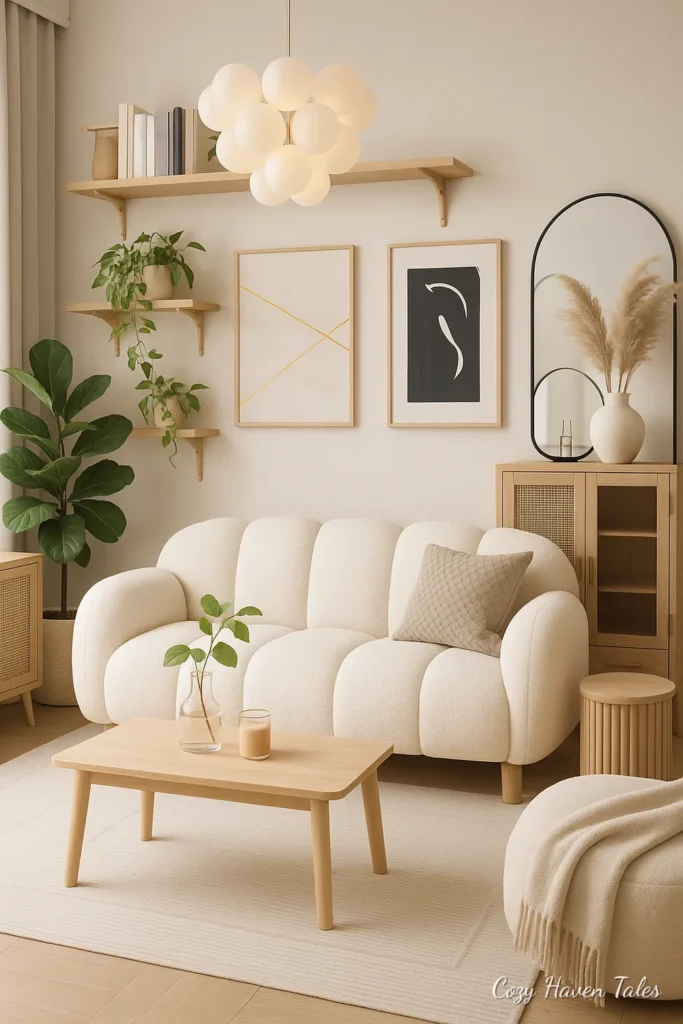
This one works because nothing on it shouts. Light wood, a cream sofa, a little pampas, and a few pale ceramics — it feels calm the moment you walk in, which is exactly what a busy household needs from its main room. It’s best in a living room or a bedroom that gets good daylight. Display dried stems, a couple of rounded ceramic vases, two or three books laid flat, and one piece of soft art.
My tip: hold yourself to two or three natural tones and let the wood and the cream do the talking. The mistake I see most is adding a bright accent “to liven it up” — it breaks the calm that makes the look work. This shelf works beautifully in a space where calm matters more than making a statement. The same quiet, natural balance sits at the heart of Japandi style if you’d like to take the look further.
2. Alcove Shelves That Use Forgotten Space
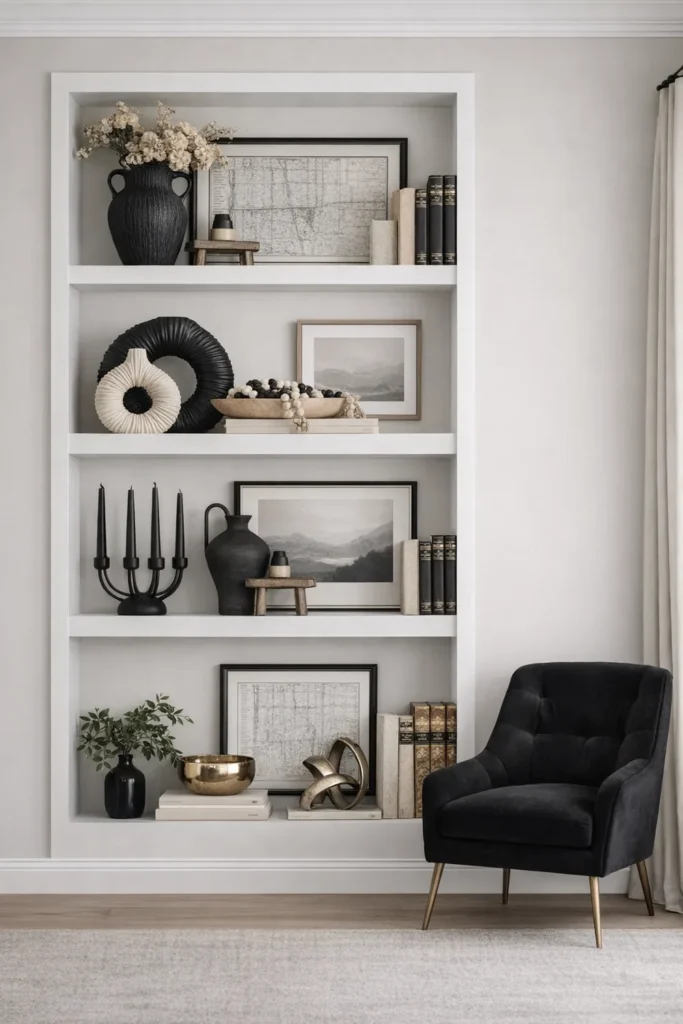
The clever part here is the location: shelves set into the alcove beside a chimney breast or a recessed wall, space most people leave empty. Built in like this, plain shelves start to look like part of the architecture. Best in a living room or dining room with a natural niche. Style it gallery-fashion — a tall sculptural vase, a small stack of books, one object with a bit of height, and a piece of art leaning at the back.
My tip: paint the back wall of the alcove a shade or two darker than the surrounding wall, and the objects suddenly stand forward. The common mistake is painting the niche the same colour as the rest of the room, which flattens all that lovely depth. Lovely for anyone renovating who wants a built-in, high-end feel without a big budget.
3. Floating Shelves on a Wood Slat Wall
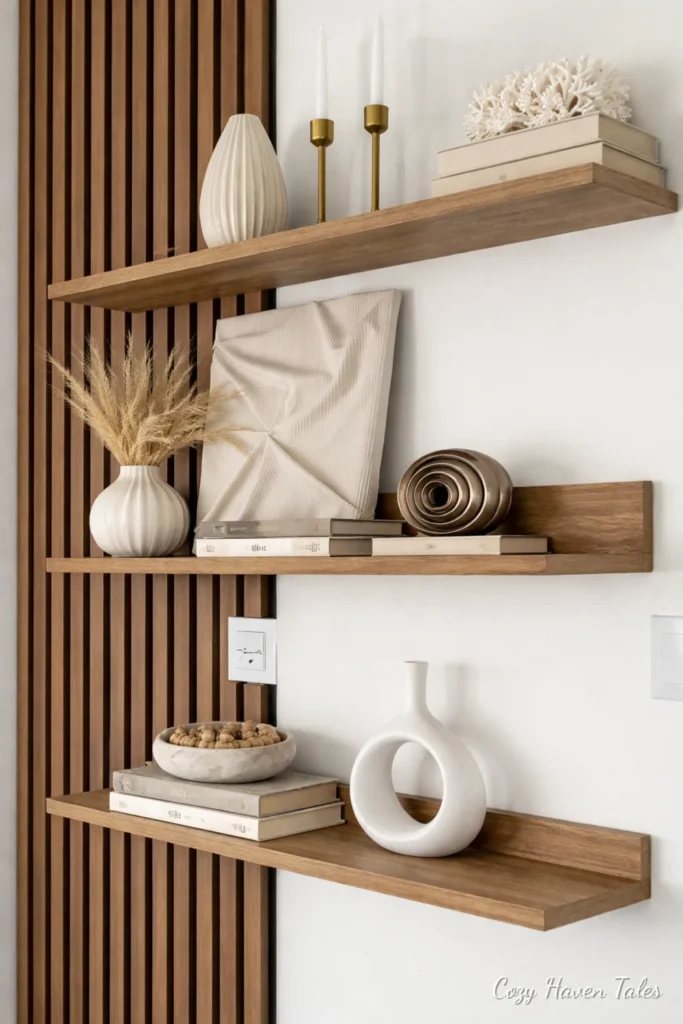
Mount slim wood shelves onto a slatted wall and two nice things happen at once — the slats hide the brackets, and the texture does half the decorating for you. It suits a feature wall in a living room, hallway, or behind a desk. Because the wall is already doing visual work, keep the shelves sparse: two or three quiet objects, a low bowl, a single vase.
My tip: is restraint — the fewer things you place, the more those vertical lines get to breathe. The mistake is loading the shelves until the slats disappear and you’ve lost the very thing that made the wall special. This is for the homeowner who likes warm, modern wood and wants one wall to feel considered without going bold on colour.
4. A Tall Corner Unit That Owns the Corner
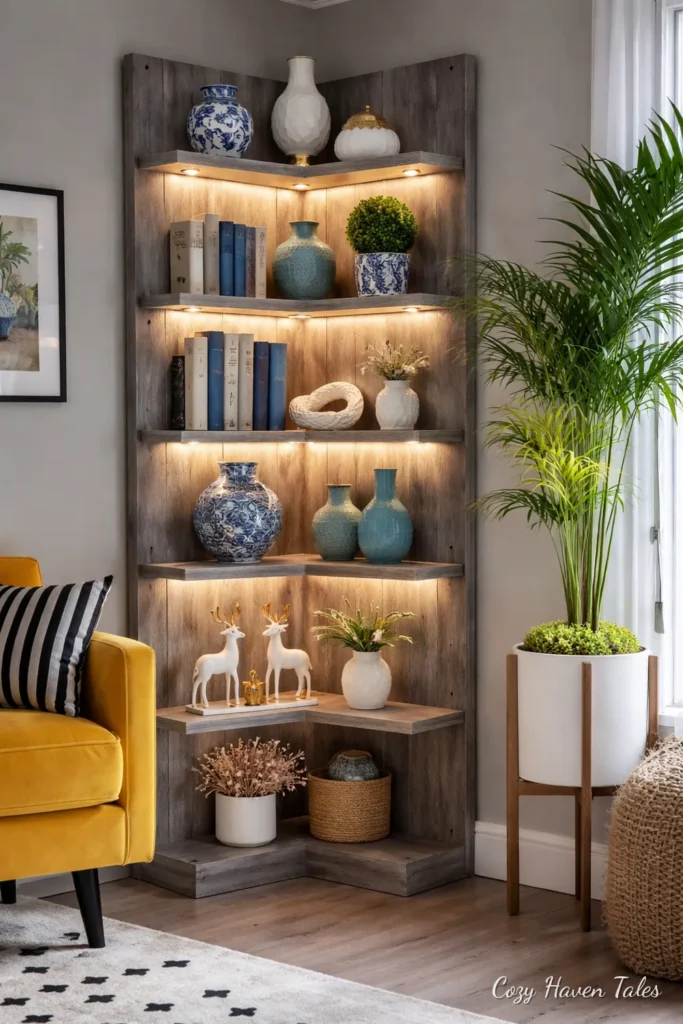
Here the whole idea is height: a floor-to-ceiling unit tucked into a corner, lit from within, that pulls your eye upward and makes the ceiling feel taller. Best in a living room corner that currently holds nothing but a sad floor lamp. Display a mix — pottery, a couple of plants, and one or two pieces in a colour you love lower down where they read clearly.
My tip: keep the heavier, denser objects on the lower shelves and let the top ones stay light, so the tower feels grounded. And always warm light, never cool blue-white. The mistake is filling every single shelf evenly, which turns a feature into a storage rack. Made for someone with an empty corner and an appetite for a little drama.
5. Bright White Corner Shelves for Book Lovers
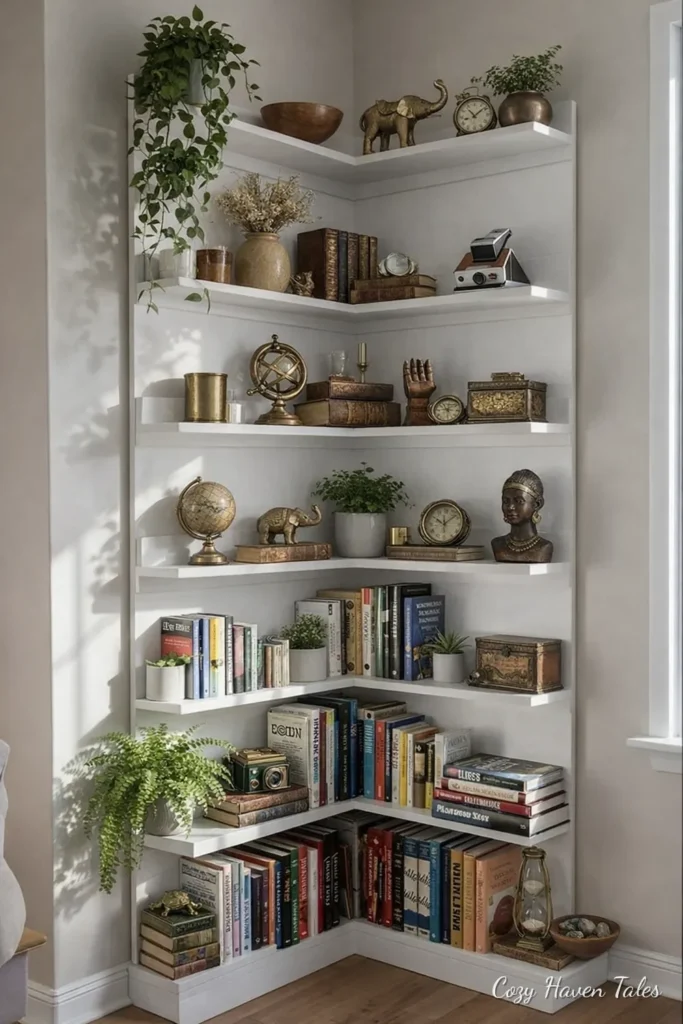
White corner floating shelves filled with books and green plants
Title: White Corner Floating Shelves with Books and Plants
Caption: Bright white corner shelves styled with books and greenery.
Description: Crisp white corner floating shelves wrapping around two walls and
styled with books, baskets and leafy plants — an airy, space-saving
corner open shelving idea.
White shelves that wrap around two walls of a corner feel airy and open, even when they’re holding a lot of books. That brightness is why they suit smaller living rooms and studies where a dark bookcase would feel heavy. Fill them with books, a few trailing plants, and a basket or two to break up the spines.
My tip: mix flat-stacked books with upright ones and leave the odd gap, so it reads as lived-in rather than packed. The mistake is arranging books into a colour rainbow — it looks like a shop display, not a home — or cramming them so tight there’s no air. Perfect for readers in compact spaces who refuse to give up their book collection.
6. A Freestanding Metal Shelf as a Room Divider
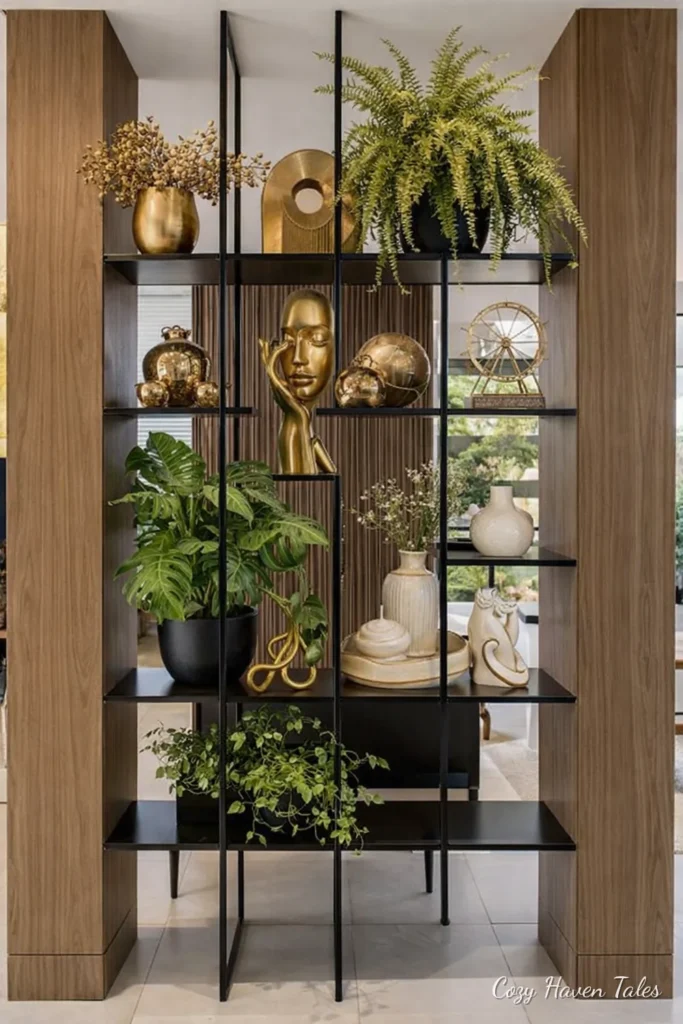
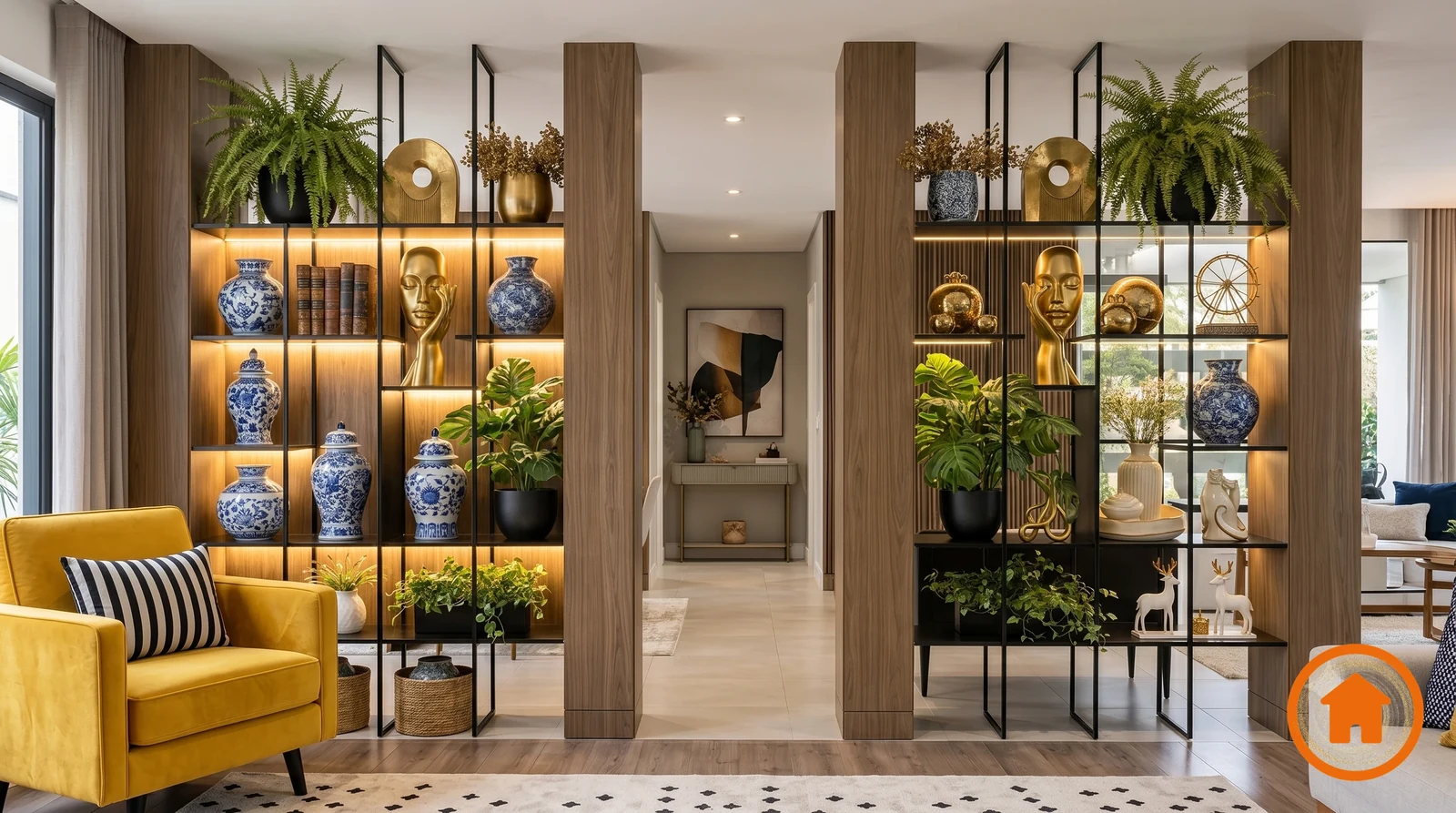
This open metal unit earns its place by splitting a space without walling it off — light still travels straight through it. It’s ideal in an open-plan room or a studio where you want to suggest “this is the living bit, that’s the dining bit.” Style both sides, because people see it from both: light objects, a few plants, a sculptural piece, nothing too solid.
My tip: is to keep the very top shelf airy so the divider doesn’t feel like a barrier. The mistake is treating it like a real wall and overloading it until it blocks the light it’s meant to let through. Especially good for renters — no fixed walls, no drilling — and anyone in an open-plan home.
7. A Backlit Corner Shelf for a Home Office
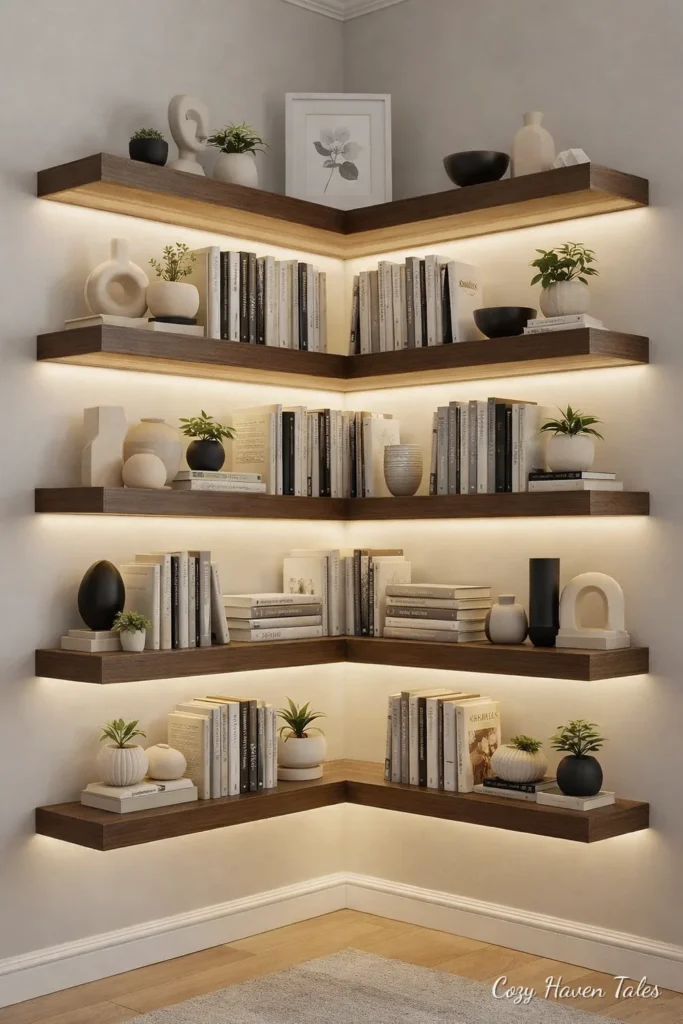
Warm light tucked behind corner shelves does something quietly brilliant in a workspace: it makes a work corner feel like a calm nook instead of a chore. Best above or beside a desk in a home office. Keep it simple — a few books, one plant, a framed print — and let the glow be the feature.
My tip: keep your actual work clutter (cables, sticky notes, that stack of paper) off the lit shelves, because the light shows everything. The mistake is using cool, bright task lighting up here, which feels clinical and undoes the cosiness. This is for anyone working from home who wants their office corner to feel less like an office. If that’s you, my home office ideas cover the rest of the setup.
8. Built-In Shelves Over Closed Cabinets
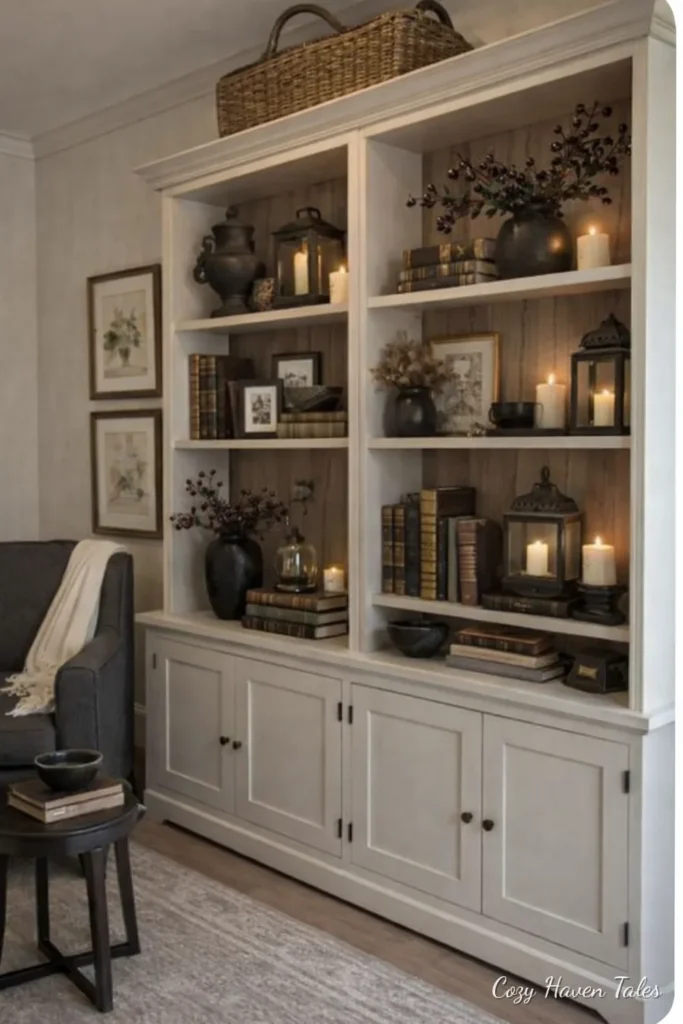
This is the most practical idea in the whole list, because it gives you both: open display up top, closed storage down below. It works beautifully in a living room or family room where real life needs hiding. Use the open shelves for the things you’re happy to show — a few vases, candles, greenery, art — and let the cabinets swallow the chargers, games, and clutter.
My tip: only fill the open part about two-thirds full, even though the storage below is bursting. The mistake is treating the open shelves as extra storage too, which defeats the point of having doors at all. Made for families and anyone who loves the open look but knows, honestly, that they have a lot of stuff.
9. An Angular Wood Corner Shelf as Sculpture
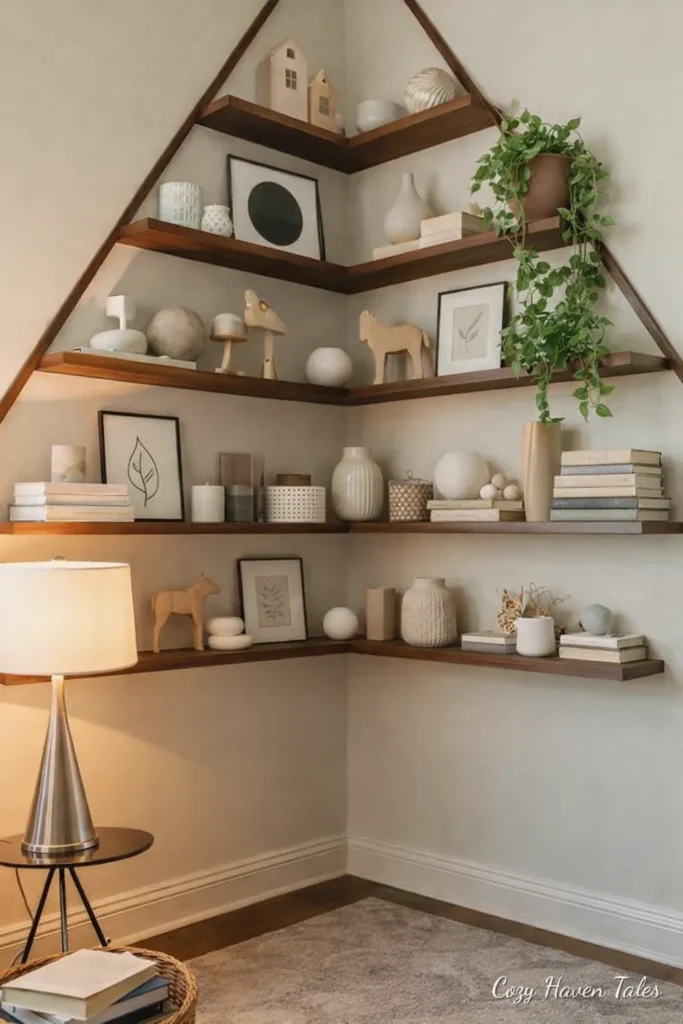
Angular wood corner shelving with a sculptural silhouette.
When a corner shelf has an interesting geometric shape, the shape itself becomes the decoration. That’s why this one barely needs styling to look good — best in a living room or bedroom corner you want to feel a little design-led. Display sparingly: a couple of objects, a trailing plant, plenty of empty space.
My tip: is to work in odd numbers and vary the heights so your eye moves around the form. The mistake is over-styling and burying the very angles that make it special. This suits the homeowner who wants one piece that feels like a deliberate design choice rather than just storage.
10. Floating Shelves Above the Sofa
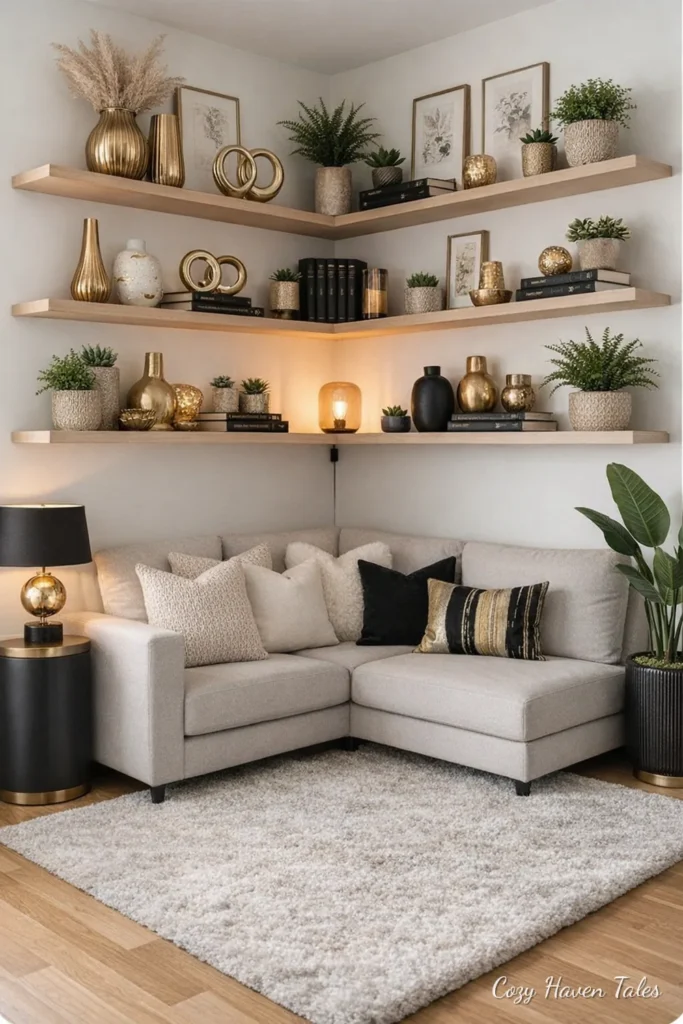
If you only try one idea from this list, make it this one. The wall above a sofa is the most-seen blank space in most homes, and a couple of floating shelves fill it without adding a single thing to the floor. Best, obviously, in the living room above your main seating. Style with a piece of art, a plant that trails a little, and some books laid flat for weight.
My tip: hang the lowest shelf fairly low — roughly a hand’s-width-and-a-bit above the sofa back — so the shelf and sofa read as one group, not two floating elements. The mistake is hanging them up near the ceiling, which leaves the wall looking top-heavy and disconnected. This one’s for everyone; it’s the easiest high-impact upgrade I know. Pair it with a gallery wall on the same wall if you want more art in the mix, and there are plenty of other ways to style the wall behind your sofa if shelves alone don’t fill it.
11. Shelves Above the Bed Instead of a Headboard
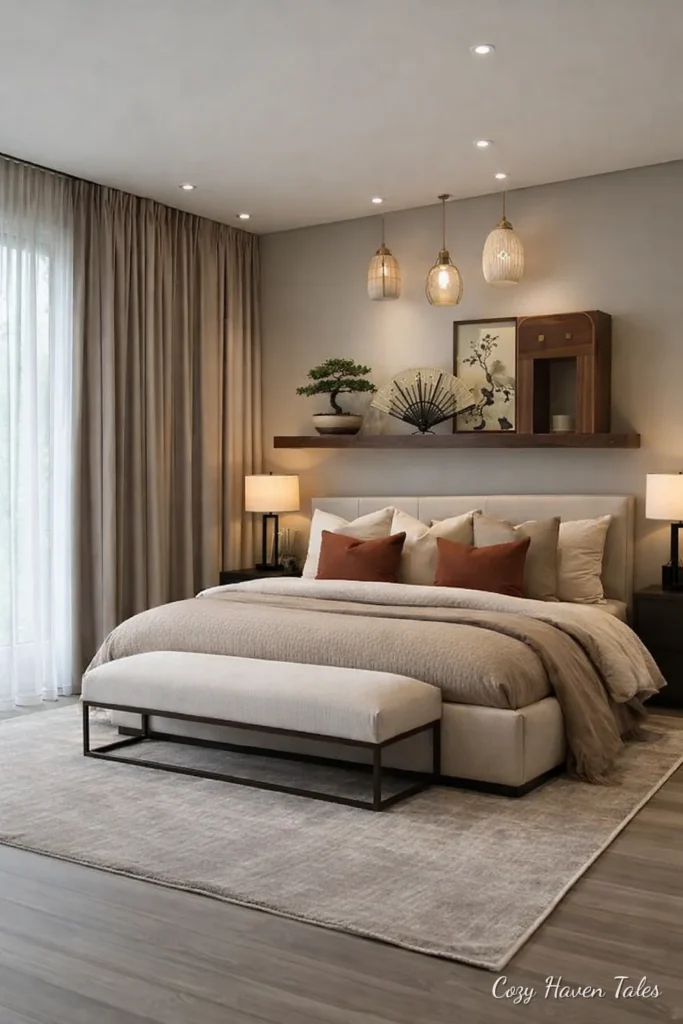
Floating shelves above the bed can stand in for a headboard and free up the floor where bulky furniture used to go. Best in a bedroom — particularly a small one where every inch counts. Keep what’s overhead soft and light: a small plant, a framed print, a little warm light, nothing heavy.
My tip: is to let a gentle glow up here set the mood for the room. The mistake — and it’s an important one — is putting heavy books or hard objects directly above your pillows. This is for the small-bedroom owner who wants the calm of a headboard wall without the cost or bulk of an actual headboard.
12. A Rustic Shelf Wrapped in Warm String Lights
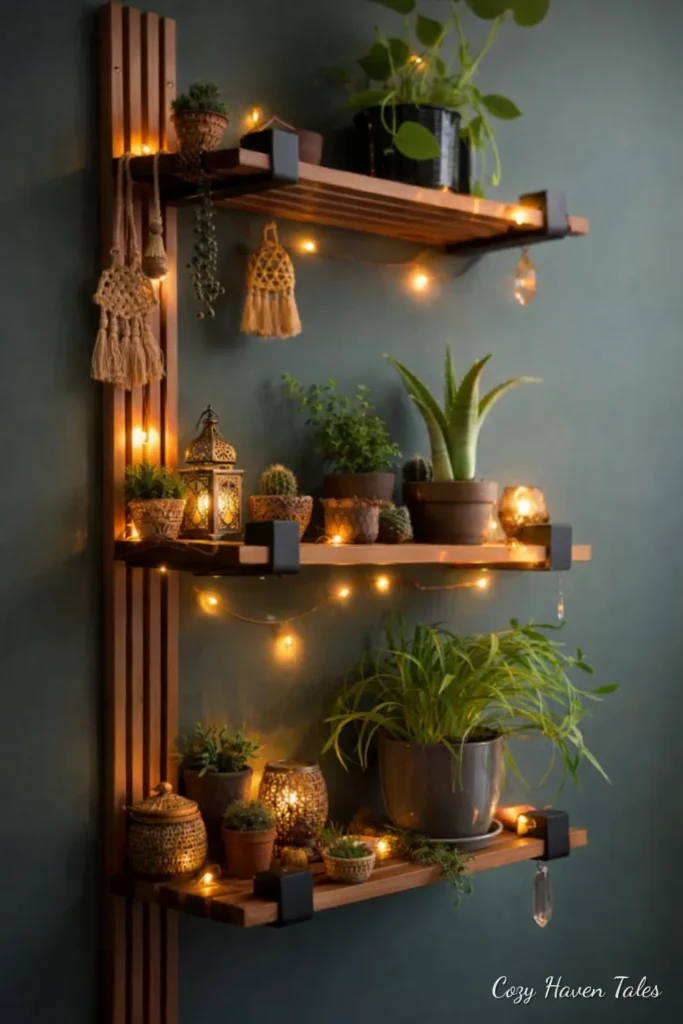
Some shelves are about storage; this one is purely about mood. Warm wood, a few plants, and soft string lights make the cosiest corner in the house. It’s lovely in a reading nook, a bedroom corner, or even a balcony. Display trailing plants, a candle or two, and let the little lights weave through.
My tip: only ever warm-white lights, and tuck the wire out of sight along the back edge. The mistake is reaching for cool blue lights, or crowding the shelf with gadgets that kill the softness. Made for the homeowner who wants a warm, switch-off-the-world corner — and it happens to be renter-friendly too.
13. A Layered Corner Shelf for a Collected Look
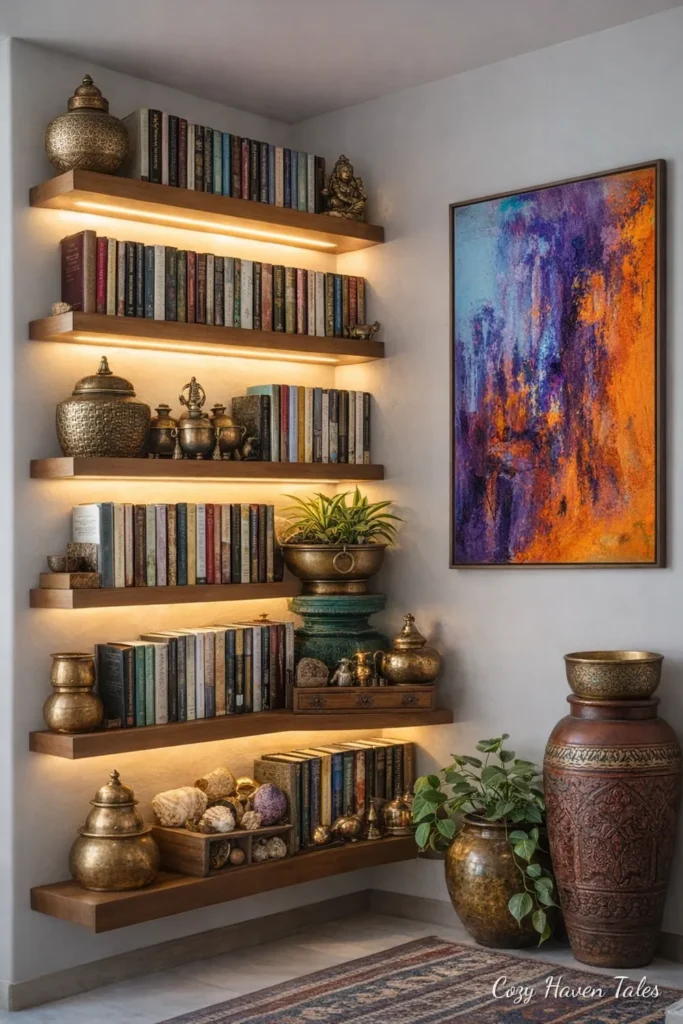
This corner feels personal because it’s layered — books, earthy pottery, a piece of art — the kind of shelf that looks gathered over years rather than bought in an afternoon. Best in a living room corner or a study. Display things with a shared, earthy feeling: handmade ceramics, well-loved books, one bit of colour from a canvas.
My tip: is to group objects by material or tone so the mix still feels connected rather than random. The mistake is a true free-for-all of mismatched bits, which reads as clutter no matter how nice each piece is. This suits collectors and travellers who want their things on show without the chaos.
14. Shelves Built Into a Sloped Attic Corner
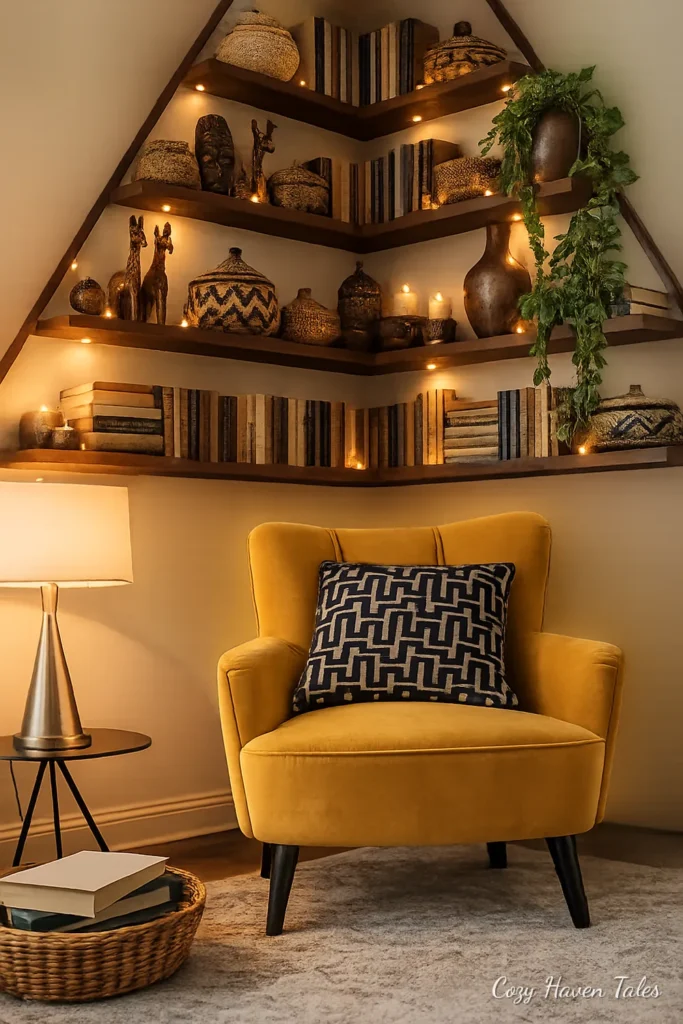
An attic slope is the kind of awkward angle most people give up on. Building shelves into it turns wasted roofline into a reading nook with character. Best in an attic bedroom, a loft, or even an under-stairs gap. Fill it with books, a little pottery, and a reading lamp so the corner earns its keep.
My tip: let the shelf heights follow the angle of the roof rather than fighting it — the slope becomes part of the charm. The mistake is leaving that triangle empty because it feels “too hard,” when it’s actually one of the cosiest spots you’ve got. For loft and attic owners, and anyone who wants a tucked-away place to read.
15. A Green Shelf Full of Trailing Plants
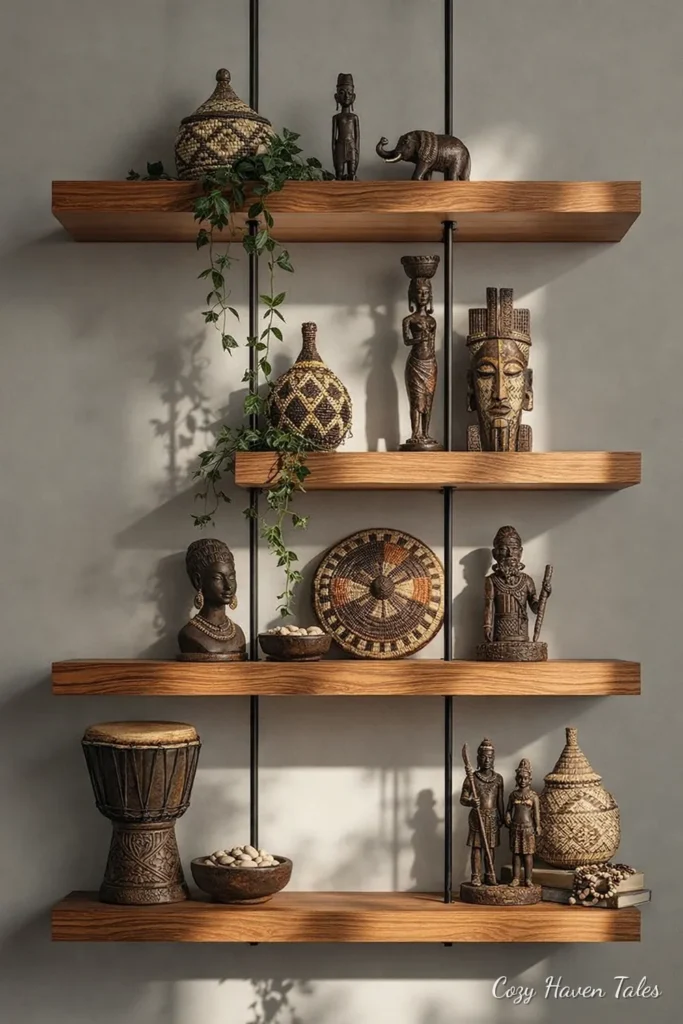
Plants are the fastest way to soften the hard, straight lines of any shelf, and this idea leans all the way into that — greenery spilling over the edges, a few objects between. Best in a living room, a bright bathroom, or a balcony. Display trailing plants that don’t mind lower light — pothos, philodendron, ivy — and let them hang down to break up the horizontals.
My tip: choose those forgiving trailing types so the look survives real life. The mistake is sticking a thirsty, sun-loving plant on a dark shelf and watching it sulk within weeks. This is for plant lovers who want their shelves to feel alive, not staged.
16. Slim Bedroom Shelves with Pendant Lights
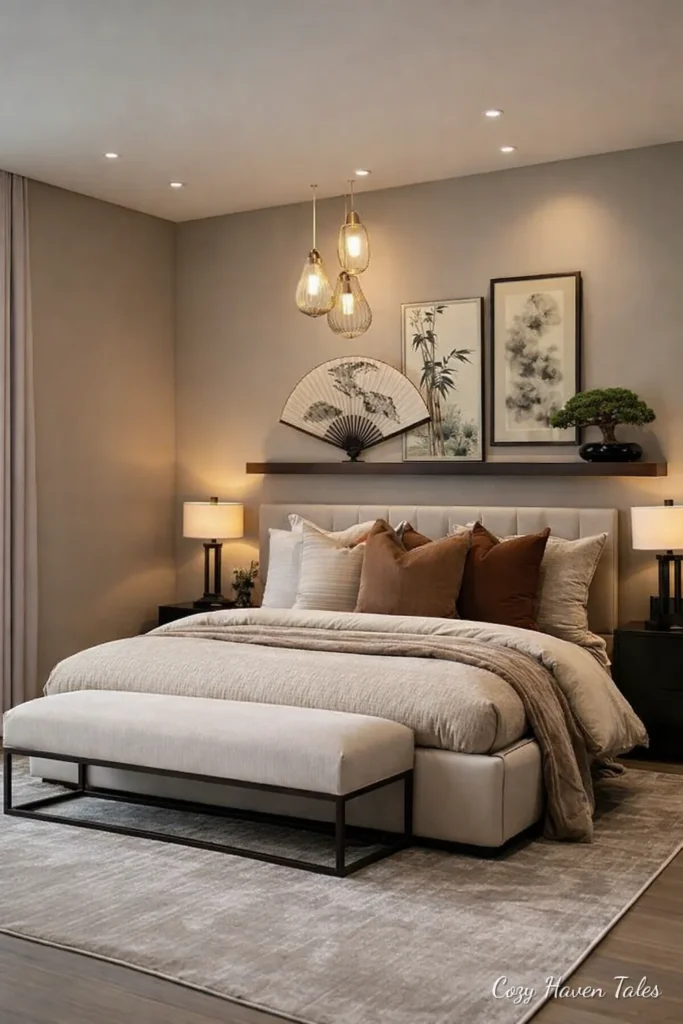
Here, narrow shelves paired with hanging pendant lights do the job of both a nightstand and a lamp — which clears the surface beside your bed and looks considered doing it. Best in a modern bedroom that’s tight on floor space. Keep each shelf to almost nothing: a single book, a small plant, one frame.
My tip: get the pendant height right (roughly where a table lamp would sit) and keep the shelves genuinely slim. The mistake is letting those narrow shelves collect odds and ends until the clean look is gone. Made for the modern homeowner with little room for bedside tables.
17. A Warm Slat Wall with Lit Shelves and Plants
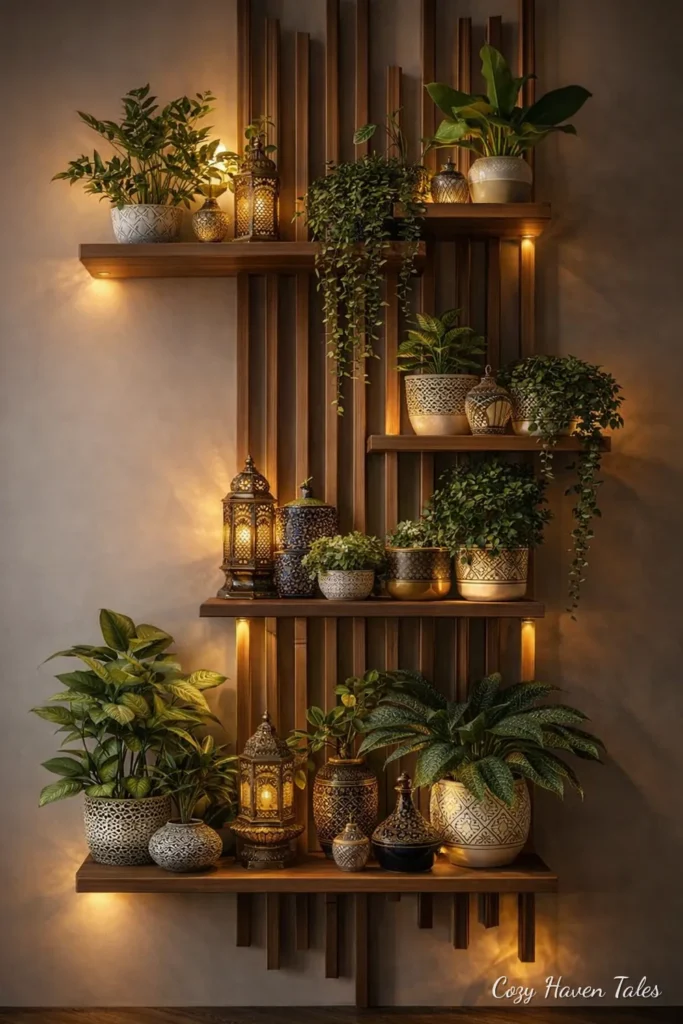
This is the richer cousin of idea three — a slatted wood wall, but now with shelves, a hidden light strip, plants, and candles layered in for evening warmth. Best as a feature wall in a living room or bedroom. Display a balance of greenery and soft light, with a candle or two for good measure.
My tip: layer the light behind the plants so the leaves glow after dark. The mistake is piling on too many competing textures until the wall feels noisy rather than warm. This suits the homeowner who wants one wall to be the heart of the room, especially in the evenings.
18. An Arched Niche with Soft Lighting
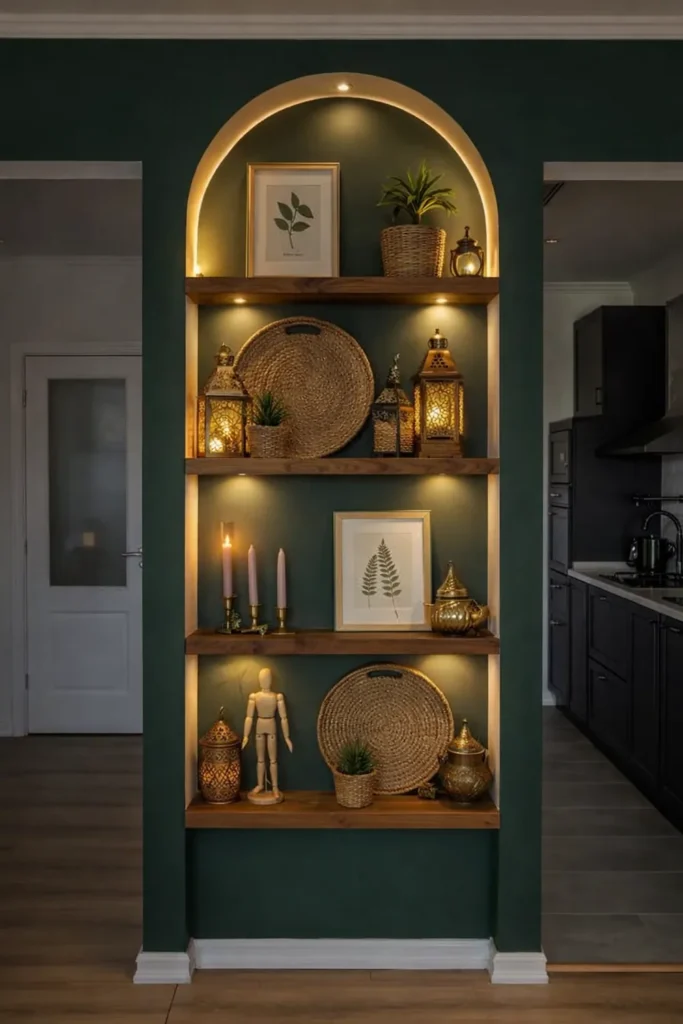
There’s a reason arched, recessed shelving is everywhere right now — the curve feels softer than hard corners, and a recess always reads as custom work. Best in a living room, hallway, or dining room where you can carve out a little depth. Style it lightly: a few objects, a piece of art, nothing crowded.
My tip: paint the inside of the niche a moody colour and run a slim light along the front edge — that’s the touch that makes it look professionally done. The mistake is painting the niche the same colour as the wall, which loses the depth entirely. For anyone renovating who wants a feature that feels expensive and current.
19. Wood Shelves Built Around Bold Art
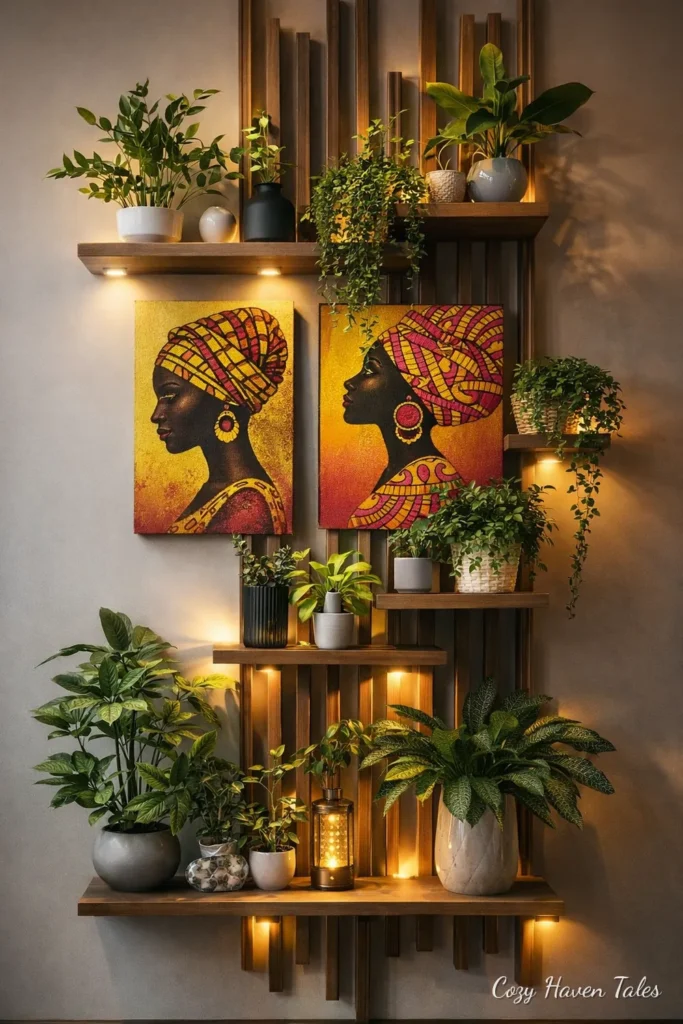
Sometimes the art should lead and the shelf should support — that’s this idea. A strong, colourful piece anchors the wall, and the shelves around it stay calm. Best in a living room or entryway that could use a hit of personality. Display one bold artwork, a few quiet objects, and some greenery so nothing competes.
My tip: let that single piece be the star and keep everything on the shelves deliberately low-key. The mistake is surrounding bold art with equally loud objects, so the whole wall fights itself. This is for art lovers and homeowners who aren’t afraid of a bit of colour. If a wall of art appeals more than shelves, my eclectic gallery wall ideas take that further.
20. Staggered Box Shelves for a Modern Wall
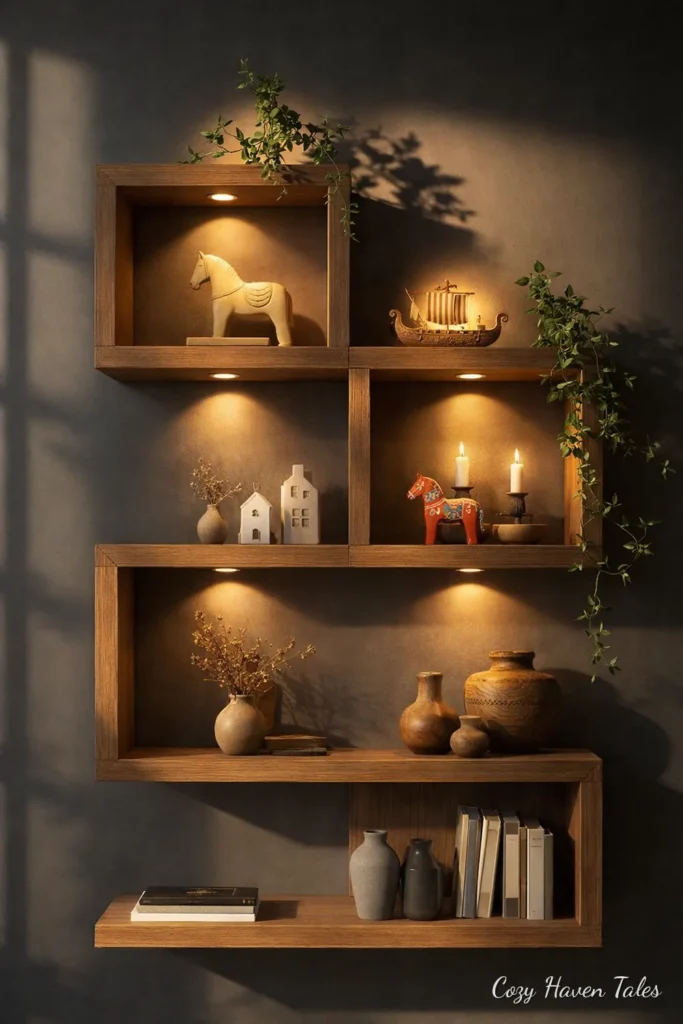
Instead of straight, even lines, these shelves stagger like little boxes at different points on the wall — the asymmetry is what makes them feel modern, and it’s brilliant on a narrow or awkward wall. Best in a contemporary living room, a hallway, or any slim wall that defeats normal shelving. Display just one or two objects per box.
My tip: leave some boxes deliberately empty, because the rhythm of full-and-empty is the whole effect. The mistake is filling every box equally, which makes the arrangement feel static and undoes the cleverness. Made for the modern homeowner with a tricky narrow wall to solve.
21. Calm Neutral Shelves Beside the Sofa
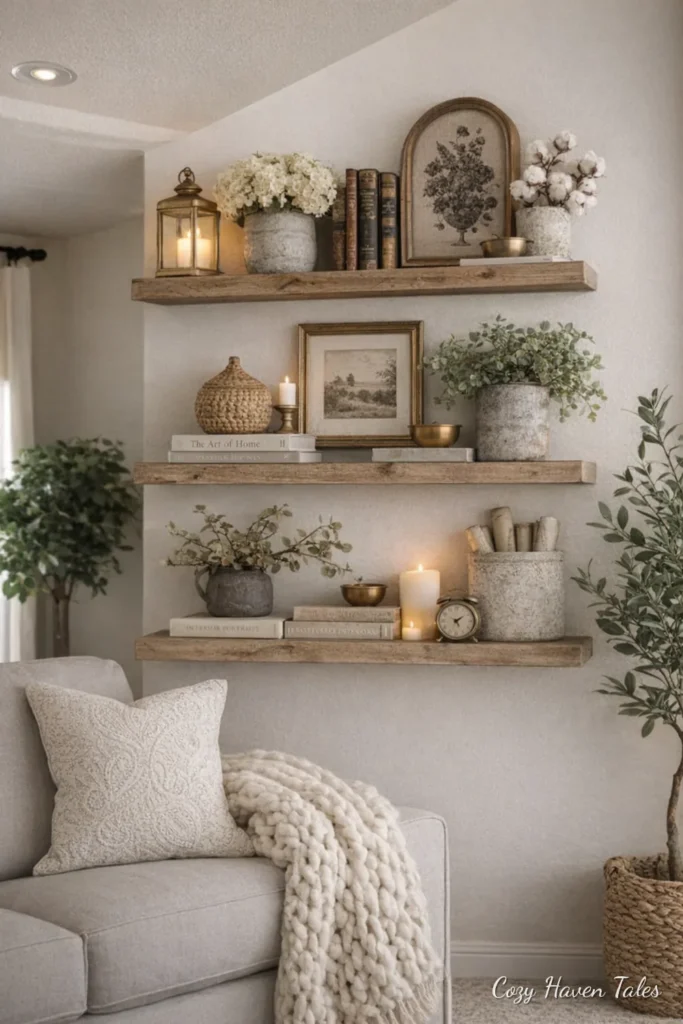
This is open shelving at its most restful — pale wood, soft tones, a candle, a plant, nothing trying too hard. Best beside a sofa in a living room you want to feel like a place to exhale. Display a few textural pieces rather than colourful ones: a linen-bound book, a wood bowl, a simple ceramic.
My tip: lean on texture instead of colour to keep it interesting without busyness. The mistake is going so bare it feels cold, or so full it loses the calm — the sweet spot is gently styled. For the homeowner who wants soothing over showy.
22. A Lit Plant Shelf Like an Indoor Garden
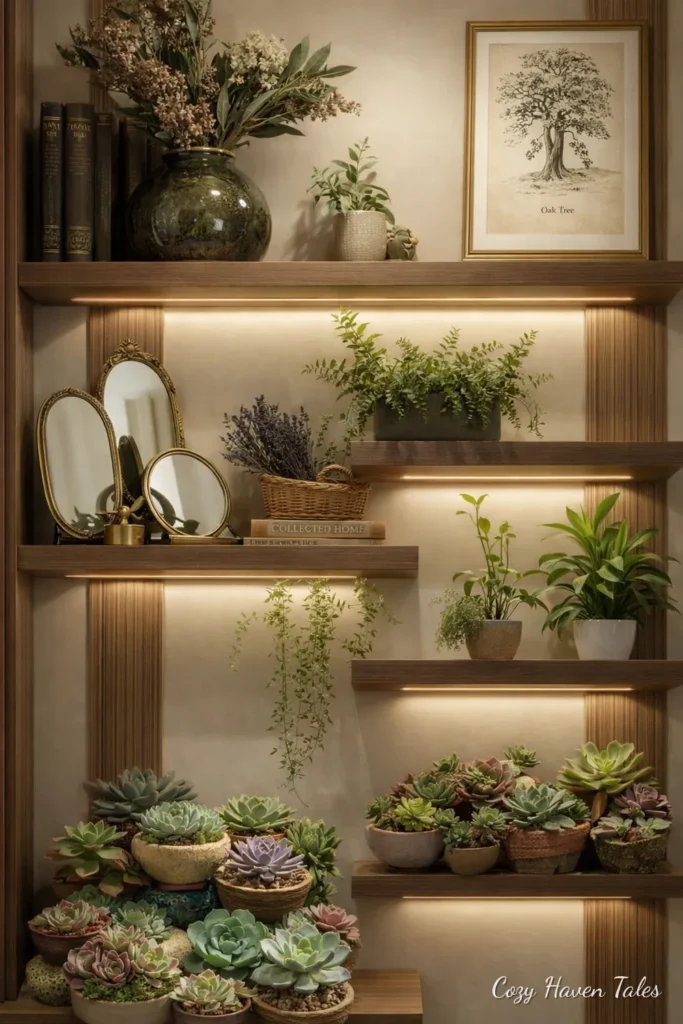
For people who genuinely love plants, this turns a wall of shelves into a small indoor garden, lit so the greenery glows. Best in a bright living room or a sunroom. Display a generous mix of succulents and trailing greenery, varying the leaf shapes and sizes.
My tip: group plants in pots that share a tone or material so the abundance still feels intentional, and vary the heights. The mistake is a jumble of clashing pot styles, which makes lush look messy. This is for the dedicated plant lover who wants greenery to be the main event, not an accent.
23. A Hexagon Shelf That Doubles as Art
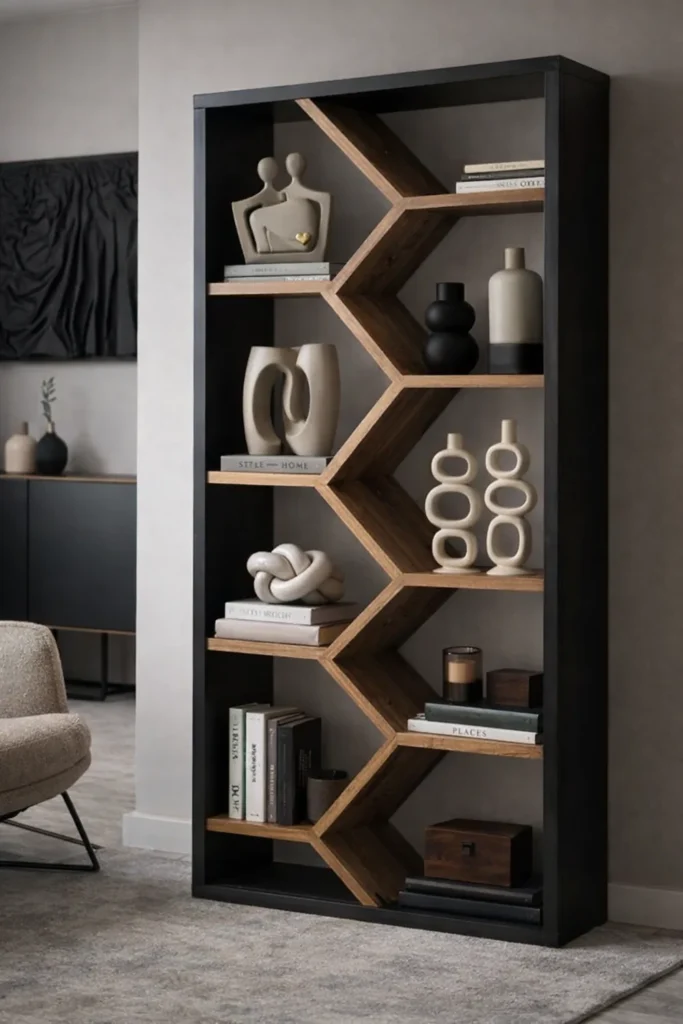
When a shelf has a shape this strong — a black honeycomb of hexagons — it stops being storage and becomes a piece on the wall. Best on a feature wall in a living room or study. Display only a handful of objects, mostly in one colour, with lots of empty cells left open.
My tip: style it like art and protect the negative space, because the pattern is the point. The mistake is filling every cell until the honeycomb shape vanishes under clutter. Made for the bold homeowner who wants one wall that stops people mid-conversation.
24. A Round Wall Shelf as a Talking Point
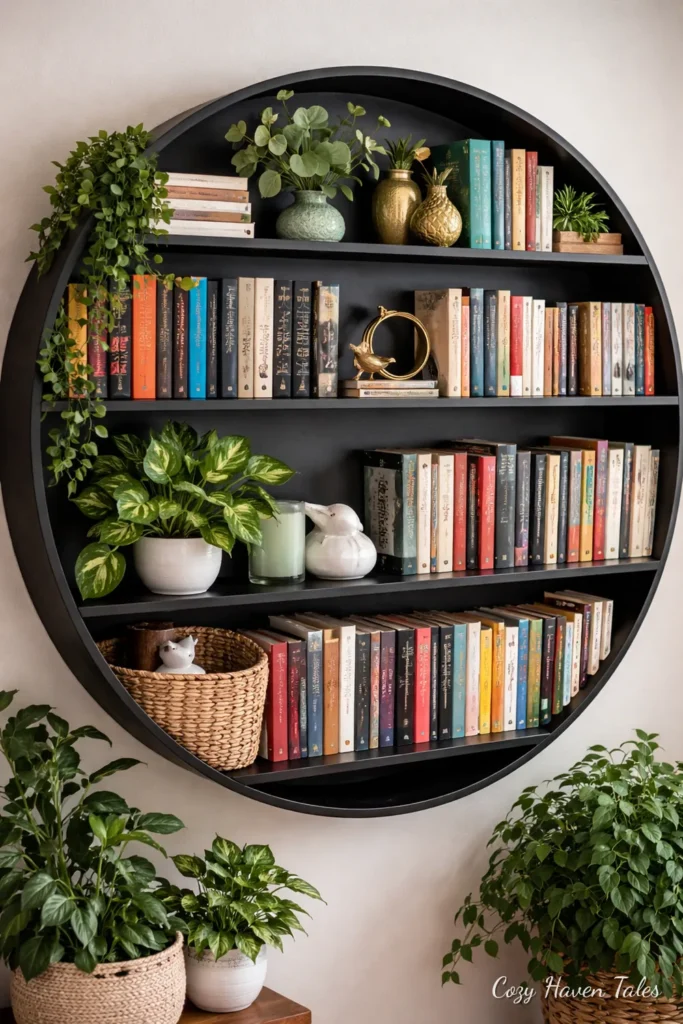
A circular shelf is unexpected enough to work as wall art on its own, while still holding books and a plant. Best in a living room or a reading corner that needs a focal point. Display a careful mix of books and a trailing plant, balanced around the circle.
My tip: spread the visual weight evenly around the ring so it doesn’t look lopsided. The mistake is overloading it until the circle disappears and you’re left with, well, a messy round box. For the homeowner who wants a genuine conversation piece rather than another rectangle.
25. A Cube Grid Shelf for Tidy Collections
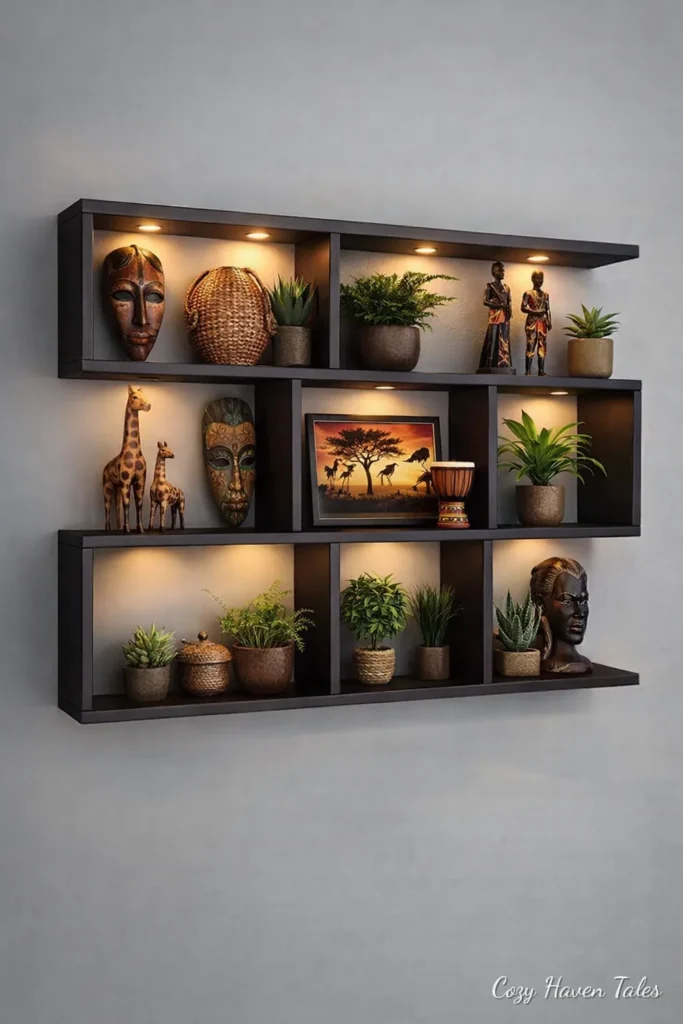
If you love order, a grid of cubes is your friend — each compartment keeps a collection separate and neat, which is why it suits a study, a living room, or a child’s display wall. Display one object (or one small plant) per cube and repeat a couple of colours across the grid.
My tip: leave a few cubes empty on purpose, because a full grid feels heavy. The mistake is stuffing every single cube until the clean structure turns into visual noise. Made for collectors who want their things shown off with a sense of order, not chaos.
26. Triangular Corner Shelves for Tight Rooms
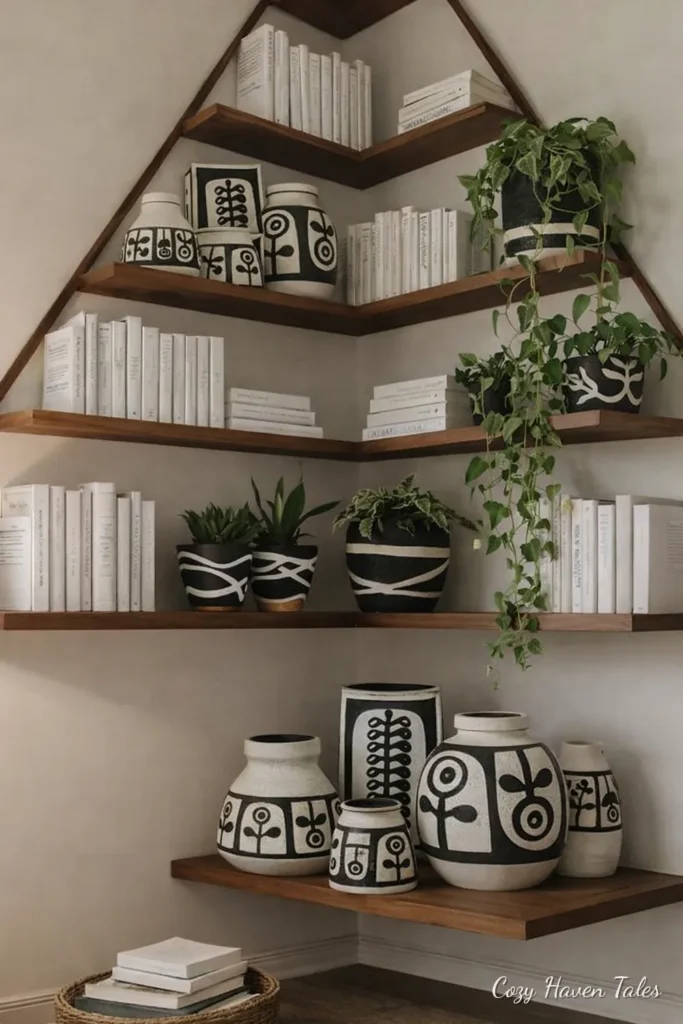
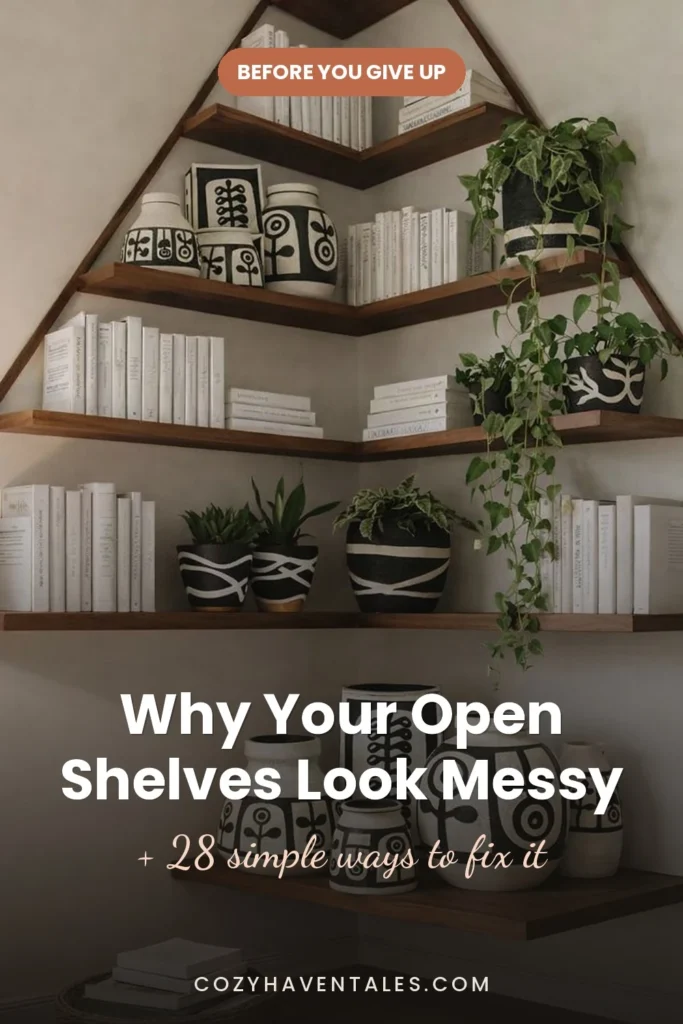
These simple triangles fit into a corner with barely any footprint, which makes them a gift in small rooms and narrow hallways. Display graphic pieces — black-and-white pottery, a few white books, one trailing plant.
My tip: stick to a two-colour story so the look stays crisp and graphic. The mistake is introducing too many colours, which muddies the clean effect that makes these shelves work in a small space. For homeowners short on room who still want a corner with a bit of personality.
27. Bedroom Shelves Layered with Framed Art
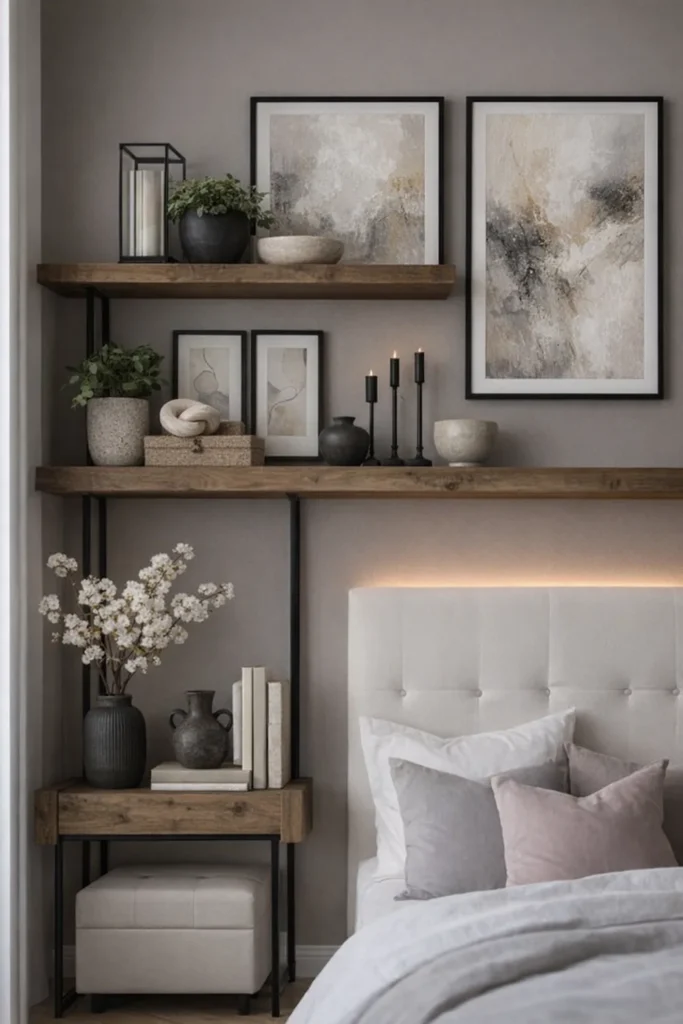
This is the refined, headboard-free bedroom look — shelves above the bed layered with framed prints, a vase, a little greenery, soft and personal. Best over the bed in a bedroom you want to feel considered and grown-up. Display framed prints, a small vase, and a plant, leaning some pieces rather than hanging them all.
My tip: lean and overlap the art, layering pieces slightly in front of each other for depth. The mistake is spacing everything out perfectly centred, which looks stiff and showroom-like rather than personal. For the homeowner who wants a calm, gallery-feel bedroom without a headboard. If you’d rather go bold behind the bed instead, see my maximalist ideas for the wall behind the bed.
28. A Boho Bedroom Shelf with Woven Texture
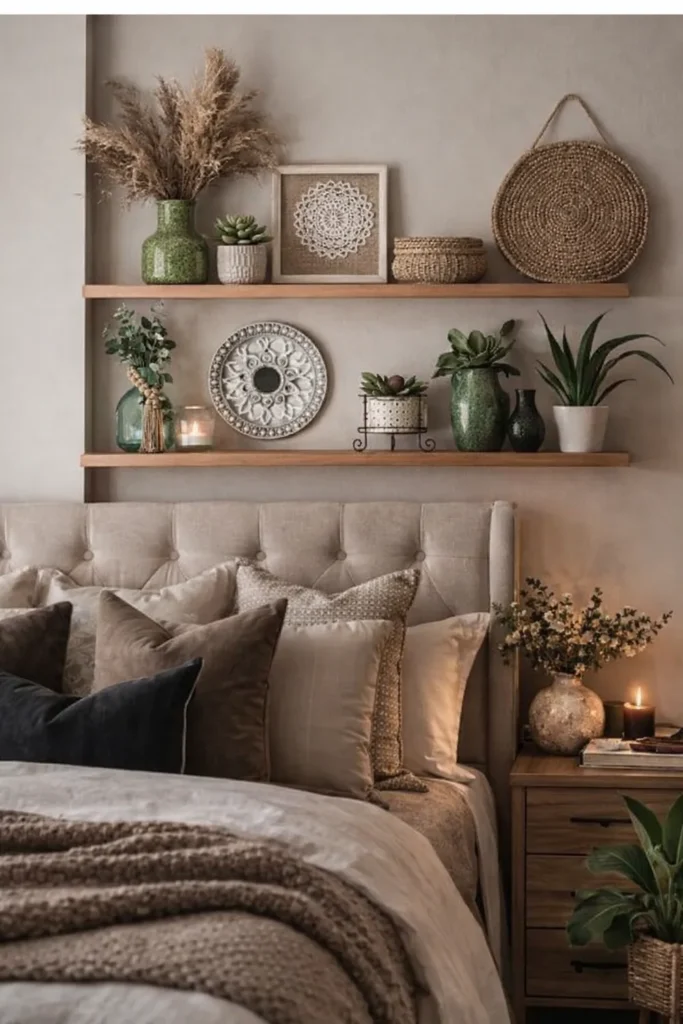
We finish warm: wood shelves above a bed layered with woven baskets, a wall hanging, dried stems, and plants — all about texture and softness. Best in a bedroom or a guest room you want to feel welcoming. Display natural textures together — jute baskets, wood, pampas, a trailing plant.
My tip: mix several natural materials so the warmth has depth. The mistake is using all one material, which falls flat; texture needs contrast to feel rich. For the homeowner who loves a relaxed, natural, boho-leaning bedroom — and if that’s your style, my boho wall ideas are worth a look too.
For more ideas room by room, my decor by room guides take this further.
How to Style Open Shelves (The Method I Use Every Time)
If you remember nothing else, remember this: a good shelf is mostly air. Here’s the simple method I use in every home.
- Fill about two-thirds, leave one-third empty. The empty space is what makes it look designed instead of stored.
- Vary the heights. Mix something tall, something medium, and something low so your eye travels across the shelf.
- Group in odd numbers. Threes almost always look better than twos or fours.
- Pick two or three colours and repeat them. Random colours read as clutter; a small palette reads as a plan.
- Layer front to back. Put a piece of art at the back, something medium in front, something small in front of that — depth makes a flat shelf come alive.
- Mix textures. Wood, ceramic, woven, glass, a soft book — contrast keeps a calm palette from feeling dull.
- Step back often. Style, walk away, look from across the room, then take one thing off. It’s almost always one thing too many.
What to Display on Open Shelves
The easiest way to get it right is to stick to things that look good and earn their place:
- Books — some stacked flat, some standing upright
- Ceramics and pottery, especially handmade pieces
- Plants, particularly trailing ones that soften the edges
- Woven baskets to add warmth and hide small bits
- Framed art or photos, leaned rather than perfectly hung
- Candles for height and mood
- A few warm metal or wood accents
- One personal object that means something to you
And the things to keep off open shelves: plastic containers, charging cables, paperwork, and matching “shelf decor” sets bought in one go — they always look staged.
Common Open Shelving Mistakes
- Filling every inch. The most common one by far. Edit ruthlessly.
- Everything at the same height. Flat and lifeless. Vary it.
- No colour story. Pick a few tones and stick to them.
- Cool, blue-white lighting. It makes wood look grey. Always warm white.
- Matching store-bought sets. They look like a display, not a home. Mix in real, personal pieces.
- Using open shelves to store, not display. If it needs hiding, it belongs behind a door.
- Forgetting the empty space. Breathing room is part of the design, not wasted room.
- Hanging shelves too high. Above a sofa or bed, keep them low enough to connect with the furniture.
A Quick Word on Practical Bits
You don’t need to be a carpenter, but a few numbers help. Keep shelves around 10–12 inches deep for a mix of books and objects — deeper than that looks bulky and collects clutter at the back. Leave roughly 12–15 inches between shelves for decor (a little less for books) so nothing feels squashed. Above a sofa, hang the lowest shelf about 10–12 inches above the sofa back. And do fix shelves into something solid in the wall rather than relying on light fixings alone, especially if they’ll hold books — it’s the difference between shelves that still look good next year and shelves that sag. That’s as technical as you need to get.
Open Shelving FAQs
Take a third of everything off, vary the heights of what’s left, and group items in odd numbers. Clutter is almost always a quantity problem, not a taste problem.
They gather more dust than closed cabinets, yes. But if you style them lightly, a quick wipe takes a couple of minutes. Fewer objects means less to lift and dust.
A mix of books, a plant or two, some pottery or a bowl, a framed piece leaned at the back, and one personal object — all in two or three repeating colours.
Very well. They feel lighter than closed cabinets and make a small room feel more open — just keep them styled simply so they don’t tip into looking busy.
Open for the things you want seen, closed for the things you don’t. Most rooms are happiest with a bit of both, which is exactly why built-ins with cabinets are so popular.
They can be. Look at freestanding units or room dividers that need no drilling, or lightweight picture-ledge shelves for renters who can’t make big holes.
Final Thoughts
Open shelving isn’t about owning more beautiful things — it’s about showing a few of them, well. Pick one wall, choose the idea that fits your room from the 28 above, fill it about two-thirds of the way, and step back. If it feels a touch too empty, you’ve probably got it just right. Start with one shelf, learn what you like, and let your rooms grow from there.
And if open shelving turns out not to be your thing, it’s only one way to handle a bare wall. You could fill it with other blank-wall ideas, or skip the wall decor altogether and choose a paint colour you won’t regret instead.
Related Reading
- How to Decorate Your Blank Walls: Timeless Design Inspirations
- How to Style the Wall Behind a Sofa
- How to Decorate the Wall Behind the Bed with a Maximalist Touch
- 19 Expressive Eclectic Gallery Wall Ideas
- 19 Simple and Beautiful Boho Wall Ideas
- How to Design a Gallery Wall